
Tungsten's Journey from Metal to Jewelry
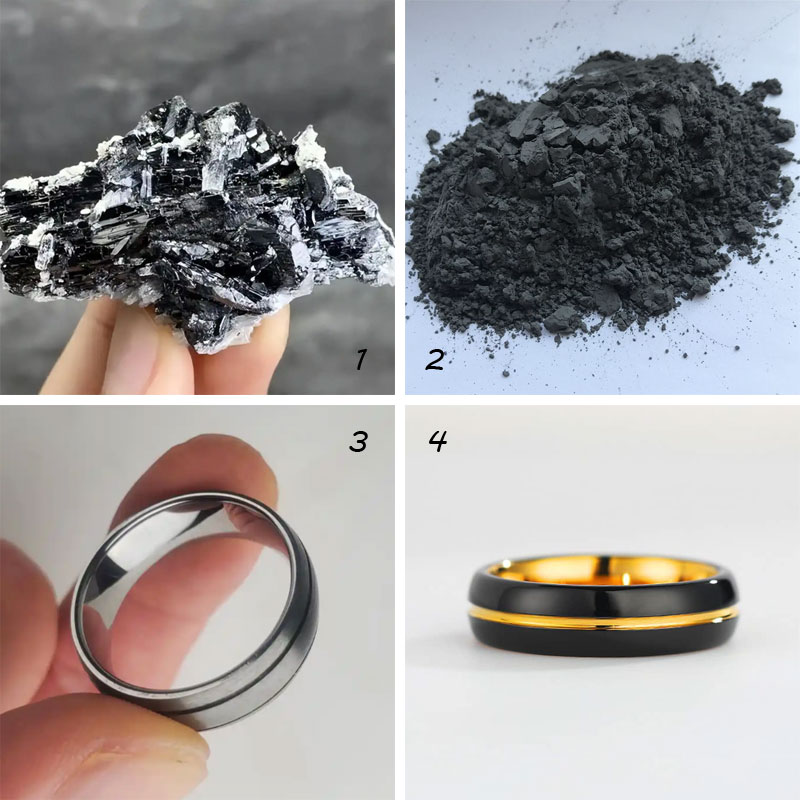
This article explores how tungsten transforms from a rugged industrial metal into a sleek piece of wearable art. It is a remarkable journey, taking the element from the depths of the earth to the display cases of high-end jewelers.
Here is how that journey unfolds:
1. The Raw Element: Born in the Earth
Tungsten starts its life underground, primarily extracted from minerals like wolframite and scheelite. After a series of refining processes, including beneficiation, purification, and reduction, pure tungsten metal is obtained as a dark gray powder.
In its raw, elemental state, tungsten features:
2. The Chemistry: Becoming Tungsten Carbide
To make it wearable, scientists mix pure tungsten metal powder with carbon powder to form tungsten carbide, a fine silver gray powder.
A metallic binder, typically nickel or cobalt, is added to the blend. We prefer nickel over cobalt because cobalt can react with skin oils, potentially causing oxidation or skin irritation.
In its alloyed form, tungsten boasts exceptional hardness, making it an ideal material for jewelry.
Note: While our product names may vary between "tungsten" and "tungsten carbide," both terms refer to the exact same high-quality tungsten carbide material.
3. The Forge: High-Tech Sintering
Because tungsten carbide cannot be melted in a regular furnace, we use a process called sintering:
Instead of melting, the particles bond at a molecular level, forming a solid, extremely dense jewelry blank.
4. The Finish: Shaping with Diamonds
Once the blank cools, it is practically indestructible. It is so hard (ranking a 9 on the Mohs hardness scale) that standard steel tools cannot scratch it. Diamond-tipped tools and diamond polishing pastes are used to shape, bevel, and polish the jewelry blank.
At this point, the journey from tungsten metal to tungsten jewelry has come to an end. The result is a piece of jewelry that is exceptionally durable, highly resistant to deformation and scratches, and capable of retaining its mirror-like finish for decades to come.
The Transformation: At a Glance
|
Feature |
Raw Tungsten Metal |
Tungsten Carbide Jewelry |
|
Hardness |
Fairly brittle, can scratch |
Scratch-proof (9 on Mohsscale) |
|
Appearance |
Dull, industrial gray |
Brilliant gray, mirror-like shine |
|
Main Use |
Lightbulbs, military, aerospace |
Lifetime-guaranteed jewelry |

All prices are listed in USD.
Copyright © 2015 - 2026 iDream Jewelry.
Copyright © 2015 - 2026 iDream Jewelry.